
Responding to Emergency Situations: Importance of Participant Location
Posted by SkillMaker in Dec, 2024
What is a concise description of understanding participant location when responding to emergency situations?

Understanding participant location is pivotal when responding to emergency situations in sports and recreational environments. Being aware of participant locations helps facilitate prompt and precise emergency responses, ensuring that aid is swiftly provided where it is most needed. This understanding plays a crucial role in managing crowd control, guiding evacuation procedures, and ensuring the overall safety of all individuals involved.
Why do people in enterprises need awareness of participant location when responding to emergency situations?
Individuals within enterprises must be cognizant of participant locations to efficiently manage emergency situations. Quick knowledge of where participants are located aids in prioritizing emergencies based on severity and immediacy, contributing to effective crisis management. This knowledge is vital for minimizing risk, preventing potential harm, and maintaining a safe environment for staff and participants alike.
“Recognising participant location during emergencies ensures swift action and prioritizes safety, enabling a coordinated and effective response.”
What are the key components or elements of knowing participant location in emergency responses?
Key components of understanding participant location during emergencies include:
- Location Tracking Systems: Implementation of technology to monitor real-time locations.
- Clear Communication Channels: Establishment of reliable communication pathways to relay location information effectively.
- Emergency Action Plans: Detailed plans incorporating knowledge of likely participant congregation points.
- Staff Training: Equipping staff with skills to identify and communicate participant locations swiftly.
- Signage and Maps: Use of visible signage and maps to assist in locating participants.
What key terms, with descriptions, relate to participant location in emergency situations?
- Incident Command System (ICS): A structured method to control emergency response situations effectively, ensuring everyone knows their location duties.
- Evacuation Zones: Designated areas for participant relocation to ensure safety during emergencies.
- Staging Area: A location established for assembly and organization of responders and resources before deployment.
Who is typically engaged with considering participant location in emergency situations?
Event coordinators, facility managers, safety officers, and emergency response teams typically handle aspects related to participant locations during emergencies. Their responsibilities include strategizing emergency response plans with location accuracy to ensure efficient safety measures.
How does the understanding of participant location integrate with other sport and recreation components during emergencies?
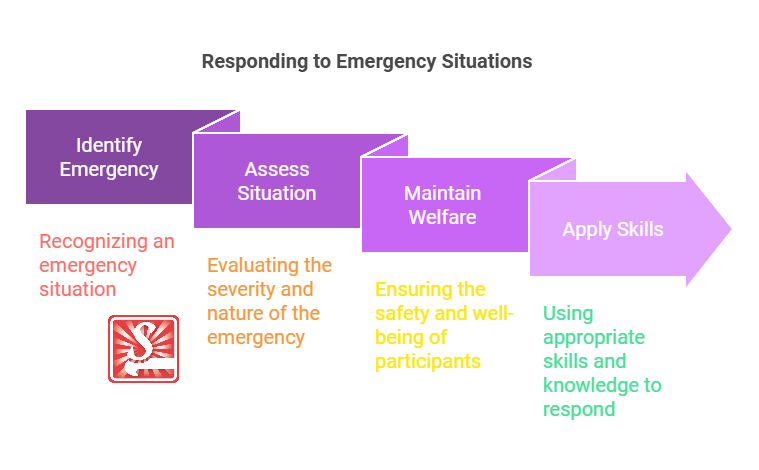
Understanding participant location during emergencies correlates with risk management practices in sport and recreation. It involves coordination between different departments to maintain communication, ensure the availability of resources, and capitalize on location insights to handle emergencies seamlessly.
Where can the student go to find more information about participant location during emergency responses?
- Safe Work Australia
- Australian Red Cross Emergency Preparation
- NSW Government – Sport and Recreation
What job roles would be knowledgeable about participant location in emergency situations?
Roles include:
- Emergency Response Coordinators
- Facility Managers
- Safety Officers
- Event Organizers
- Security Personnel
What is understanding participant location during emergencies like in relation to sports, family, or schools?

In sports, understanding participant location resembles a team optimizing their positioning for game strategy.
In a family, it aligns with knowing where all family members are in case of a household emergency.
In schools, it is akin to teachers ensuring students are accounted for and safe during drill exercises or actual emergencies.”
(The first edition of this post was generated by AI to provide affordable education and insights to a learner-hungry world. The author will edit, endorse, and update it with additional rich learning content.)
- About the Author
- More info

Workskill training for all

 Post Tagged with