
Mastering the Forward Lunge in Strength and Conditioning
Posted by Jonny BBAD Nelson in Dec, 2024

What is a concise description of the forward lunge when instructing strength and conditioning techniques?
The forward lunge is a dynamic exercise that involves stepping forward with one leg while bending the knees to lower the hips until both knees are bent at a 90-degree angle. This movement is a fundamental component of strength and conditioning, as it builds lower body strength, enhances balance, and promotes functional movement patterns critical for sports performance and overall fitness.
Why do people in enterprises need to master the forward lunge?
Enterprises, particularly those involved in sports coaching, fitness training, and physical rehabilitation, require proficient mastery in executing and instructing the forward lunge. It’s crucial for creating well-rounded training programs that improve athletes’ performance by developing leg strength, enhancing mobility, and reducing the risk of injury through balanced muscle development. Furthermore, the forward lunge is vital for teaching individuals proper mechanics that translate to various sport-specific movements.
“The forward lunge is a foundational movement for building lower body strength, enhancing mobility, and promoting functional fitness, making it a versatile tool in both athletic and everyday training environments.”
What are the key components or elements of the forward lunge?
The key components of the forward lunge include:
– Stance and Alignment: Start with feet shoulder-width apart, maintaining an upright torso and engaged core.
– Step and Descent: Take a controlled step forward, bending both knees to lower the hips. Ensure the front knee aligns over the ankle, not extending past the toes.
– Balance and Stability: Keep the body stable during the movement to prevent wobbling. Balance is maintained by engaging the core and keeping the back straight.
– Return to Start: Push through the front heel to return to the starting position, maintaining alignment and control throughout the movement.

Registered Trademark®
What key terms, with descriptions, relate to the forward lunge?
– Stability: The capacity to maintain control over the body’s movement and position during the lunge.
– Muscle Activation: Involvement of muscles, primarily the quadriceps, glutes, hamstrings, and calves, during the forward lunge to perform the exercise effectively.
– Functional Movement: Movements that resemble everyday actions or sports-specific activities, promoting better performance and reducing injury risk.
Who is typically engaged with operating or implementing forward lunges?
Forward lunges are commonly used by strength and conditioning coaches, personal trainers, physical therapists, and athletic trainers. These professionals employ the forward lunge as a versatile exercise for athletes, fitness enthusiasts, and rehabilitative clients due to its numerous functional benefits and adaptability to various intensity levels.
How does the forward lunge align or integrate with other components of strength and conditioning techniques for Sport Coaching and fitness?
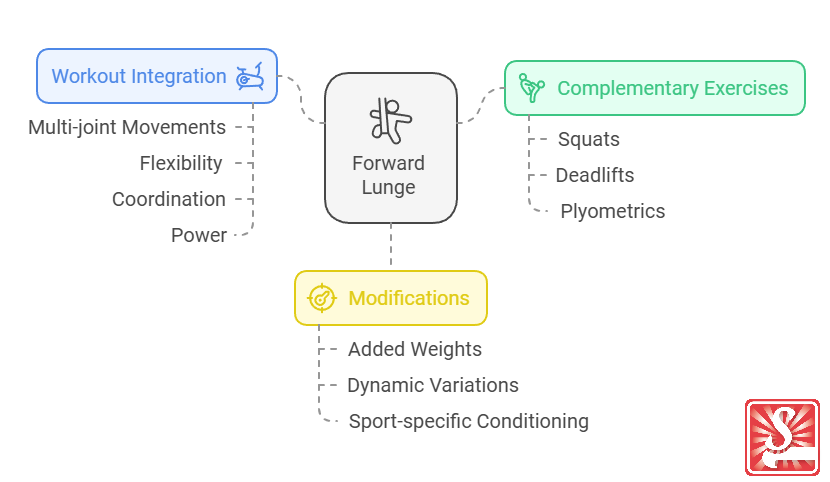
The forward lunge complements other strength exercises such as squats, deadlifts, and plyometrics by focusing on unilateral leg strengthening and balance. It forms part of a comprehensive workout that incorporates multi-joint movements, enhancing flexibility, coordination, and power. Additionally, lunges can be modified with added weights or dynamic variations to target specific fitness goals and sport-specific conditioning.
Where can students go to find out more information about forward lunges?
Students can explore further information through resources like:
– Textbooks: NSCA’s Essentials of Strength Training and Conditioning.
– Professional Fitness Websites: Resources from NSCA or ACE.
– Online Tutorials: Instructional video platforms.
– Workshops: Industry-specific seminars and hands-on training events.
– Research Journals: Exercise science journals for evidence-based practices.
Scope of Practice Document
Adult Pre-Exercise Screening System
Australian Sports Commission
What job roles would be knowledgeable about the forward lunge?
Job roles knowledgeable about the forward lunge include:
– Strength and Conditioning Coach
– Personal Trainer
– Sports Coach
– Physical Education Teacher
– Physiotherapist
– Exercise Scientist

What is the forward lunge like in relation to sports, family, or schools?
In sports, the forward lunge is fundamental for developing lower body strength, agility, and resilience against injuries, benefiting athletes in sports like soccer, basketball, and tennis. In family or school settings, lunges can be a part of general fitness programs to promote healthy lifestyle habits, improve physical education participation, and encourage the adoption of exercise from a young age, ensuring balanced growth and activity.
(The first edition of this post was generated by AI to provide affordable education and insights to a learner-hungry world. The author will edit, endorse, and update it with additional rich learning content.)
- About the Author
- More info

Jonny “B Bad” is a powerlifting specialist, strength and conditioning coach, and co-owner of Fortitude Barbell in Brisbane. With over 15 years in the industry, he has trained athletes of all levels, focusing on strength, community, and continual learning. A competitor in some of Australia’s top powerlifting events, he balances training, coaching, and family life while co-hosting The Platform Podcast. His philosophy is simple: train hard, have fun, and enjoy the process. Whether lifting big, improving fitness, or gaining confidence, Jonny’s passion is helping people get stronger—both physically and mentally—while fostering a supportive and engaging training environment.

 Post Tagged with