
Essential Elements of Conducting and Completing a Sale by Auction
Posted by SkillMaker in Feb, 2026
What is a concise description of the elements needed to conduct and complete a sale by auction?

Conducting and completing a sale by auction involves overseeing a competitive bidding process where prospective buyers place bids on a property or item until the auctioneer confirms the winning bid. This process includes effective marketing, maintaining legal compliance, and facilitating smooth post-auction transactions to ensure both vendor satisfaction and buyer commitment.
Listen to this article as a podcast
Why do people in the Real Estate industry need to understand the elements of conducting a sale by auction?
Understanding the elements of conducting a sale by auction is essential for professionals in the Real Estate industry to maximise property exposure and secure the best price for the vendor through competitive bidding. Auctions offer a transparent sales process that sets a definitive sale date and generates interest through urgency, attracting serious buyers and potentially yielding higher final sale prices.
“Successfully conducting a sale by auction can transform the marketplace dynamics by creating competition, transparency, and urgency, all of which can lead to optimum selling outcomes.”
What are the key components or elements of conducting and completing a sale by auction?
Key components when conducting and completing a sale by auction include:
- Auctioneer Engagement: Hiring a licensed and experienced auctioneer to drive the bidding process.
- Property Marketing: Strategically promoting the property to attract potential buyers.
- Compliance & Contracts: Ensuring all legal and regulatory requirements are met before and during the auction.
- Bidder Registration: Verifying and registering all potential buyers to bid at the auction.
- Post-auction Processes: Finalizing the sale by completing necessary paperwork and handling the exchange of contracts and deposit.
What key terms, with descriptions, relate to conducting a sale by auction?

Registered Trademark®
- Reserve Price: The minimum price the seller is willing to accept for the property, known only to the auctioneer.
- Under the Hammer: Refers to a property being sold at auction once the auctioneer announces a successful highest bid accepted by the vendor.
- Vendor Bid: A bid made by the auctioneer on behalf of the seller to drive momentum in the bidding.
- Hammer Price: The final bid accepted by the auctioneer to sell the property.
- Withdrawn: If bids do not meet the reserve price, the auction may be withdrawn.
Who is typically engaged with operating or implementing a sale by auction?
Professional auctioneers, real estate agents, and legal advisors are typically responsible for implementing a sale by auction. These roles ensure that the auction is conducted lawfully, ethically, and efficiently, with the aim of achieving the best sale outcome for the vendor.
How does conducting and completing a sale by auction align or integrate with other components of the Real Estate industry in Australia?
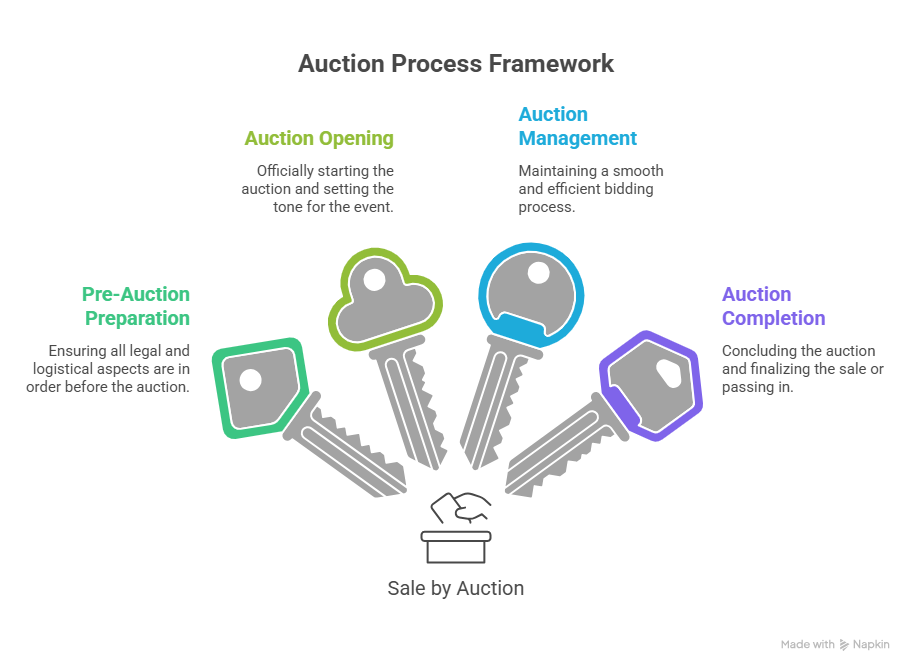
Conducting and completing a sale by auction aligns with other real estate processes through property marketing strategies, compliance with legal frameworks, and engagement with buyer and seller networks. Auctions complement private treaty sales by offering an alternative timeframe and method to meet market demands and characteristics.
Where can the student go to find out more information about conducting and completing a sale by auction?
- General rules for conducting an auction of goods
- The law and authority of auctioning real property
- Skillmaker
What job roles would be knowledgeable about conducting and completing a sale by auction?
Roles include:
- Auctioneers
- Real Estate Agents
- Property Valuers
- Legal Advisors
- Bidder Advocates
What is conducting and completing a sale by auction like in relation to sports, family, or schools?

In sports, conducting an auction is like an intense athletic event where participants compete in real-time, on-the-spot decision-making.
For families, it’s akin to a dynamic gathering where everyone competes to acquire desired items, balancing cost against enthusiasm.
In schools, it presents an opportunity for practical learning about economics, strategy, and negotiation, engaging participants in real-world buying and selling dynamics.
(The first edition of this post was generated by AI to provide affordable education and insights to a learner-hungry world. The author will edit, endorse, and update it with additional rich learning content.)
(Skillmaker – 2025)- About the Author
- More info

Workskill training for all
