
Mastering the Trial Close Strategy in Auction Sales
Posted by SkillMaker in Feb, 2026
What is a concise description of using trial close strategies in auction sales?

Using trial close strategies in auction sales involves engaging potential buyers in a manner that allows you to gauge their interest and readiness to commit to a purchase. This technique can help in adjusting your approach to meet bidder expectations and foster a competitive environment that could lead to a successful sale.
Listen to this article as a podcast
Why do people in the Real Estate industry need trial close strategies in auction sales?
Trial close strategies in auction sales are essential for Real Estate professionals to effectively gauge the interest and motivation of potential buyers. By understanding bidder behaviour and readiness, agents can tailor their tactics, enhance competition, and maximise final sale prices, ultimately benefiting sellers and improving their own outcomes.
“Trial close strategies sharpen negotiation prowess, providing insights into buyer sentiments and strengthening the pathway to successful auction closures.”
What are the key components or elements of trial close strategies in auction sales?
Key components of trial close strategies in auction sales include:
- Engagement Techniques: Methods to involve potential buyers emotionally and logically.
- Open-Ended Questions: Prompts that encourage potential buyers to express their opinions and intents.
- Signal Recognition: Ability to identify verbal and non-verbal cues indicating interest levels.
- Feedback Mechanisms: Opportunities to gather and utilise bidder feedback to adapt sales tactics.
- Adaptive Approach: Flexibility in presentation and negotiation based on bidder responses.
What key terms, with descriptions, relate to trial close strategies in auction sales?

Registered Trademark®
- Trial Close: A technique used to test how ready a potential buyer is to make a purchase.
- Buyer Signals: Indications from a potential buyer that show interest in the property.
- Bid Acceptance: The action of accepting a bid and progressing towards finalizing the sale.
- Competitive Bidding: A strategy to stimulate interest and drive up the price by creating a sense of scarcity or urgency among bidders.
- Buyer Engagement: Ensuring potential buyers are actively participating and interested throughout the auction process.
Who is typically engaged with operating or implementing trial close strategies in auction sales?
Auctioneers, real estate agents, and sales associates are typically responsible for implementing trial close strategies in auction sales. These professionals employ techniques to gauge bidder interest, adjust sales tactics, and foster an environment conducive to successful transactions.
How do trial close strategies in auction sales align or integrate with other components of the Real Estate industry in Australia?
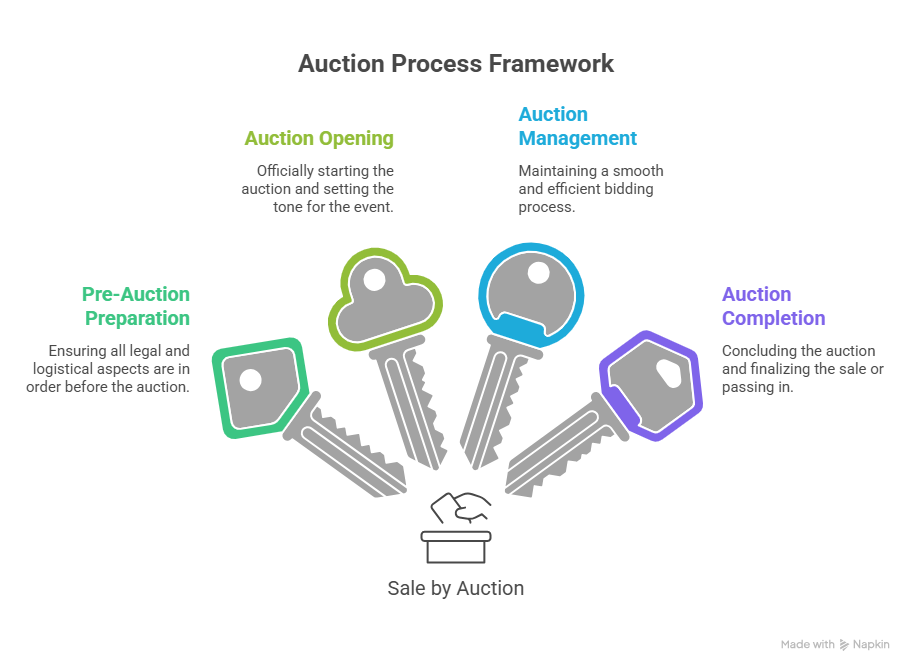
Trial close strategies are well-integrated within the Real Estate industry in Australia as they suit both auction settings and private sales contexts. By refining negotiation techniques, enhancing bidder engagement, and maximising final sale results, trial close strategies contribute to broader goals of customer satisfaction, marketability, and competitive advantage in real estate dealings.
Where can the student go to find out more information about trial close strategies in auction sales?
- General rules for conducting an auction of goods
- The law and authority of auctioning real property
- Skillmaker
What job roles would be knowledgeable about trial close strategies in auction sales?
Roles include:
- Auctioneers
- Real Estate Agents
- Sales Associates
- Property Consultants
- Real Estate Trainers
What is using trial close strategies in auction sales like in relation to sports, family, or schools?

In relation to sports, using trial close strategies in auction sales is like a coach strategically playing each quarter, making tactical adjustments based on how the game unfolds.
In a family context, it resembles parents gauging which activities engage their kids and changing plans accordingly.
When considering schools, it reflects teachers assessing class interest and adjusting lessons to enhance engagement and learning outcomes.
(The first edition of this post was generated by AI to provide affordable education and insights to a learner-hungry world. The author will edit, endorse, and update it with additional rich learning content.)
(Skillmaker – 2025)- About the Author
- More info

Workskill training for all
