
Understanding Auctions: Completing a Sale by Auction
Posted by SkillMaker in Feb, 2026
What is a concise description of conducting and completing a sale by auction?

Conducting and completing a sale by auction involves managing the public, competitive bidding process where potential buyers vie for ownership of property, whether real estate, goods, or other assets. It is a structured event with defined rules and regulations to ensure fairness and transparency in the transaction, crucial for obtaining the best possible sale price in the open market.
Listen to this article as a podcast
Why do people in the Real Estate industry need to conduct and complete a sale by auction?
Auction sales are particularly advantageous in real estate for maximising exposure to potential buyers and achieving a competitive sale price. They create urgency and competition, often leading to a faster sale than traditional private treaty methods. Highly suitable for unique, valuable, or in-demand properties, auctions are a strategic tool in any real estate professional’s toolbox to effectively market and sell listings.
“Mastering the auction process is essential for real estate professionals striving for competitive sales outcomes and maximising property value.”
What are the key components or elements of conducting and completing a sale by auction?
Key components include:
- Pre-Auction Marketing: Advertising and promoting the auction listing to attract potential buyers.
- Vendor and Buyer Briefings: Educating all involved parties on auction procedures and requirements.
- Conducting the Auction: Interactive bidding led by an auctioneer to achieve the highest sale price.
- Post-Auction Follow-Up: Completing sale paperwork and processing contracts if the reserve price is met or negotiations if passed in.
- Legal Compliance: Ensuring the auction meets all legal and regulatory standards.
What key terms, with descriptions, relate to conducting and completing a sale by auction?

Registered Trademark®
- Reserve Price: The minimum price a seller is willing to accept during an auction.
- Bid Increment: The set amount by which bids must increase during the auction.
- Hammer Price: The final winning bid at which the item or property is sold.
- Vendor’s Bid: An acceptable bid placed on behalf of the seller under auction rules.
- Passed In: A term used when a property does not meet the reserve price and is not sold during the auction.
Who is typically engaged with operating or implementing conducting and completing a sale by auction?
Key figures usually include auctioneers, real estate agents, vendor representatives, and legal support to ensure the auction process is executed smoothly and according to set rules. These roles are crucial in facilitating a successful auction event, ensuring all transactions are recorded, and meeting all legal requirements.
How does conducting and completing a sale by auction align or integrate with other components of the Real Estate industry in Australia?
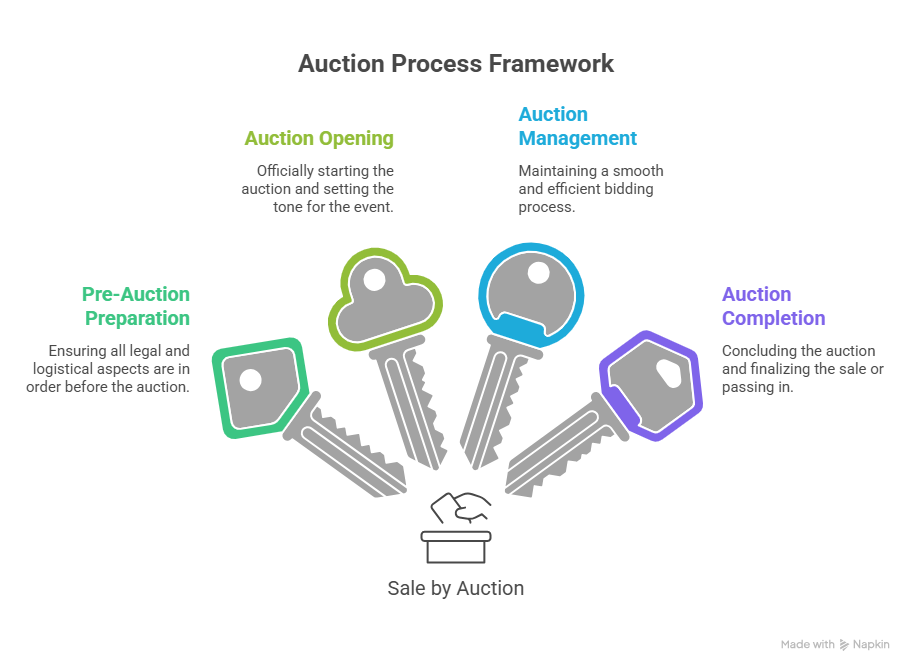
Auctions are a significant aspect of the Australian property market, integrating seamlessly with traditional real estate practices and regulations. They provide a public, transparent selling process that can complement private sales and offer competitive market assessment opportunities for all involved professionals. Moreover, auctions often highlight current market demand, aiding agents in advising clients about market conditions.
Where can the student go to find out more information about conducting and completing a sale by auction?
- General rules for conducting an auction of goods
- The law and authority of auctioning real property
- Skillmaker
What job roles would be knowledgeable about conducting and completing a sale by auction?
Roles include:
- Auctioneers
- Real Estate Agents
- Property Managers
- Legal Advisors
- Auction Coordinators
What is conducting and completing a sale by auction like in relation to sports, family, or schools?

Just as in sports, conducting a sale by auction requires strategy, timing, and skill to outbid the competition and secure a win. In a family context, it’s similar to making collective group decisions under time constraint pressure. Within schools, it can relate to academic competition—where students are driven to achieve their best against peers, aiming for the top position leveraging their knowledge and preparatory work.
(The first edition of this post was generated by AI to provide affordable education and insights to a learner-hungry world. The author will edit, endorse, and update it with additional rich learning content.)
(Skillmaker – 2025)- About the Author
- More info

Workskill training for all
