
Understanding Motivation in Leading Adventure-Based Learning Activities
Posted by Solomon Heathdale in Sep, 2024
*This article was written with the help of AI and is currently being edited by the author (30th NOV 2024)
Adventure-based learning activities are designed to challenge individuals mentally, physically, and emotionally. We use them to foster personal and professional growth. Effective leadership in such activities requires a deep awareness of motivation.
So what do aspiring outdoor leaders need to know about motivation when leading adventure-based learning activities?
Motivation is what drives participants towards the desired outcome. Motivated individuals are willing to step out of their comfort zones, embrace challenges, and actively contribute to the group’s success.
Leaders who understand motivation understand what drives their participants. They are more effective at can inspiring and support participants through the learning process.
Leaders who ignore motivational factors are leading blind. Leaving potential growth, meaning and rewards for their participants on the table.
Key Components of Motivation in Adventure-Based Learning Activities:
1. The Basis of Motivation:
At its most basic, motivation is potential reward vs current satisfaction.
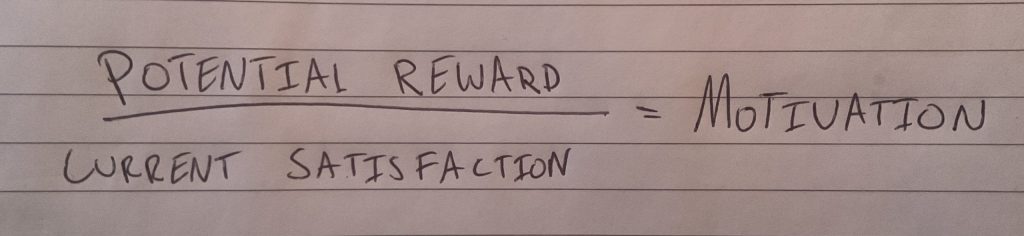
The reward for drinking water is hydration. The better the water (Better the reward) and thirstier you are (less satisfied) the more motivated you are to drink.
It is often more effective to focus on reducing satisfaction rather than trying to increase reward.
The opposite of fully satisfied is fully deprived.
Someone lost in the dessert (Fully deprived) they will be highly motivated to drink anything they can (minimal reward)
Whereas you can offer someone their favourite drink (Maximum potential reward), but if they have just chugged 3L of it (fully satisfied), they will not be motivated to drink.
To maximise motivation, the reward should be large, visceral and clear. And you should be as deprived (unsatisfied) as possible)
2. Intrinsic and Extrinsic Motivation:
“Live by an inner scorecard.”
If motivation requires a potential reward and a current level of dissatisfaction, then these factors have to come from somewhere.
They can either come intrinsically (from within), or extrinsically (from an outside source).
–
If we say that someone is “intrinsically motivated” it is a way of saying they have a bunch of skills that they apply to increase their possible reward or current level of deprivation. They use these skills when faced with a new scenario, to drive them into action.
If we say that someone is “extrinsically motivated” it means they rely on the external environment to deliver these increases.
Intrinsic motivation is more resilient. And encourages a person to have an inner scorecard. Choosing to pursue things in life based on their OWN values, beliefs, interests and skills.
Extrinsic motivation depends on an outside force. It can easily become wrapped up with a desire for external approval, status, reliance on a reward coming from outside yourself.
The struggle for a facilitator is that we are outside the participants. And rewards are undeniably a useful tool.
I’m a competitive person. So early on in my guiding, I was quick to turn to team 1 vs team 2 when running adventure based activities.
What happens when those that like extrinsic rewards are not given them, and their intrinsic reward skills depend on acting out/ being mischievous.
Or they turn to the extrinsic reward of getting their buddies to laugh at them?
This offers an extrinsic reward. Some benefit for beating the other team; a prize, recognition for competence, Bragging rights for beating the other team. It was quick fix to create engagement and excitement in a lot of cases.
Some groups are full of participants who have developed the skills for intrinsic motivation. Provide them with a challenge and they will find personal satisfaction and fulfilment in finding a solution or working through the problem.
Other groups are full of participants who prefer extrinsic motivation.
How can we use adventure-based learning activities to help participants develop their intrinsic motivation skills?
Some participants will naturally find satisfaction and enjoyment within themselves. They will motivate themselves to complete the task. They will
Understanding the balance between internal (personal satisfaction, enjoyment) and external (rewards, recognition) motivation can help leaders cater to diverse participant needs.
3. Ownership Of Goals:
Participants will give more importance to goals they feel ownership over.
Would you feel a bigger reward from accomplishing a goal you set by yourself? Or one assigned to you?
Do you feel more un-satisfied when you are lacking something you care about? or something random that someone says you should want?
Encouraging individuals to set personal and group goals drives motivation and provides a sense of purpose during the activities.
How can we help participants have ownership of their goals in adventure-based learning activities?
4. Ownership of Choices and Mastery:
Allow participants to make choices, foster their skill development and you will enhance their intrinsic motivation.
5. Part of the Herd:
Comparison is the thief of all joy. Because it puts you in a state of “relative deprivation”
People feel safer when they can point to the majority and say “they’re doing it on”
– one guy starts dancing, then a couple more, when it becomes a big enough crowd – suddenly heaps of people jump in.
The identity turns from “being one of the odd ones dancing” to “being one of the odd ones who AREN’T dancing”
“only 10% of you have turned this page in” vs “90% of who have turned the page in, that last 10%, you know who you are”
Make engagement in your activity the behaviour of the herd.
Guide them into the cave. You step in with your flashlight first. Going down a few steps at a time.
You don’t put them into the dark abyss and say – go all the way in now.
6. Feedback and Encouragement:
Providing constructive feedback and consistent encouragement can fuel motivation and help individuals overcome challenges.
–
Putting it all together:
What are the actions group leaders should take next time they are running adventure-based learning activities (to show they have a better understanding of motivation)?
—
Those engaged in leading adventure-based learning activities include outdoor educators, adventure guides, team-building facilitators, and experiential learning experts. These professionals play a critical role in creating and facilitating meaningful and impactful experiences for participants.
Adventure-based learning activities align with various components within the outdoor leadership sphere, such as risk management, group dynamics, and outdoor technical skills. Integrating motivation into leadership practices enhances the overall effectiveness of adventure-based learning experiences.
Students can find more information about motivation in adventure-based learning activities through reputable outdoor leadership textbooks, academic journals focusing on experiential learning, and professional organizations dedicated to outdoor education and adventure leadership.
Job roles knowledgeable about motivation in adventure-based learning activities include outdoor leadership instructors, experiential education coordinators, adventure program directors, and team-building facilitators.
In the context of sports, motivation in adventure-based learning activities shares similarities with coaching and team-building. In families and schools, the principles of motivation play a crucial role in encouraging growth, resilience, and skill development, aligning with the objectives of adventure-based learning activities.
*(The first edition of this post was generated by AI to provide affordable education and insights to a learner-hungry world. The author has edited, endorsed, and published it, updating it with additional rich learning content.)
Defining Key Terms:
– Intrinsic Motivation: Internal drive stemming from personal satisfaction, enjoyment, or interest in the activity itself.
– Extrinsic Motivation: External factors such as rewards, recognition, or competition that drive individuals to participate in an activity.
– Goal Setting: The process of identifying specific objectives to work towards, providing motivation and direction.
– Feedback: Information given to participants regarding their performance, leading to improved motivation and learning.
- About the Author
- More info

Hey, I’m Solomon.
I have over 2 years experience in the outdoor education industry. Instructing water based activities, and group leading on coastal expeditions. I am most passionate about seeing students develop as their connections within the group, and to nature.
My roles have required me to develop the ability to quickly build rapport with students and fellow staff, and quickly adapt to overcome obstacles to reach a satisfying outcome while on program.
I believe education is about changing behaviour. And that the outdoors creates a unique environment for introducing principles that will positively influence peoples lives.

 Post Tagged with