
Agenda for a meeting
Posted by SkillMaker in Apr, 2013

What is an agenda for a meeting?
An agenda for a meeting is a document given to all attendees before the meeting that lists, in order, the matters to be discussed. Also known as: order of business or meeting timetable.
An agenda is more than just a list of things to do. An agenda is a meeting program designed to allow all relevant topics to be dealt with in good order and in good time.
What is an agenda like?
An agenda is like a map that shows how to get from one place to another, and how long each part of the journey will take. Without it, you may take longer to reach your destination. You may even get lost.
What diagram best describes an agenda for a meeting?
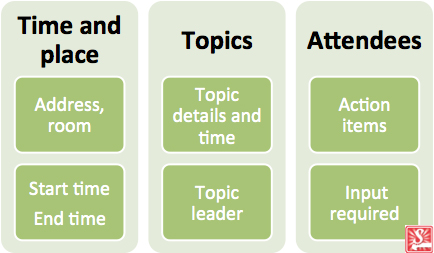
Understanding the elements of an agenda for a meeting.
What is the purpose of an agenda for a meeting?
An agenda is usually the first advice attendees get of a planned meeting. An agenda communicates important information about the meeting and what attendees have to do. Such advance notice is a basic courtesy.
An agenda also helps to ensure that a meeting is run efficiently and is a productive use of time. An agenda provides a guide to deal with the order of business—so that discussion stays on agreed topics—and to manage the time allocated for each topic.
© Skillmaker.edu.au 2013
Who prepares an agenda?
An agenda for a meeting is drawn up and distributed by the meeting facilitator, usually the chairperson. The facilitator often has an administrative officer to help with this task. Usually, the facilitator consults other attendees when preparing the agenda content.
The agenda may include a report on action items from a previous meeting. Actions items are actions that attendees agreed to (or were asked to) undertake at the previous meeting.
What’s involved in preparing an agenda?
Agendas are given to attendees before a meeting in enough time to allow them to prepare for it. Preparation may include compiling notes, collecting documents, conducting research and planning what will be said. Agendas can be distributed in printed or electronic format.
All agendas should list:
- Location and date
- Start time of meeting
- End time of meeting
- Attendees (including chairperson and note taker)
- Topics
- Topic detail (result required)
- Time allocated to each topic
- Names of attendee who will lead discussion on each topic.
How does an agenda impact on a meeting?
An agenda helps to ensure that a meeting efficiently achieves its aims. An agenda does this by:
- acting as a guide for discussion
- ensuring that attendees do not speak out of turn, or for too long
- providing a checklist to ensure that all topics are discussed
- enabling the meeting note taker to more easily record minutes.
What would happen if there were no agenda?
Without an agenda, a meeting may be disorganised and time-wasting. If attendees are not sure what they are meant to talk about—or for how long—discussions may lack control. There may be personal attacks and hostility. These inefficiencies may mean that a meeting achieves very little or nothing.
What terms are used in preparing and using an agenda?
- Action items – actions than an attendee agreed to undertake at a previous meeting (or is directed to undertake)
- Attendee – a person who participates in a meeting (in person or via electronic media)
- Chairperson – a person who controls a meeting and decides who can speak and when
- Meeting – a discussion, often in a formal setting, between two or more people about an agreed topic (or topics)
- Minutes – the official notes kept about what happened during a meeting, especially of any decisions, agreements or action to be taken
Take the Skillmaker Online Quiz now.
Latest Articles on Agenda for a meeting
- About the Author
- More info

Workskill training for all

 Post Tagged with
Great article, well written