
State Legislation for Conducting and Completing a Sale by Auction
Posted by SkillMaker in Feb, 2026
What is a concise description of state legislation for conducting and completing a sale by auction?

State legislation for conducting and completing a sale by auction refers to the legal framework and regulations established by each Australian state and territory governing the auction process. This legislation dictates how auctions must be conducted, the duties of the auctioneer, the rights of bidders, and the requirements for transparency, ensuring fair and legal transactions.
Listen to this article as a podcast
Why do people in the Real Estate industry need to understand state legislation for conducting and completing a sale by auction?
Understanding state legislation is crucial for real estate professionals involved in auctions to ensure compliance and maintain the integrity of the process. Familiarity with these laws helps prevent legal disputes, protects the interests of both sellers and buyers, and upholds industry standards. It is vital for auctioneers and agents to be knowledgeable about local regulations to run lawful and ethical auctions.
“Knowledge of state legislation is essential for maintaining the transparency and fairness of the auction process, ensuring that all transactions are legitimate and legally binding.”
What are the key components or elements of state legislation for conducting and completing a sale by auction?
Key components of state legislation include:
- Licensing Requirements: Auctioneers must be licensed to conduct sales.
- Bidder Registration: Auction participants must register before bidding.
- Reserve Prices: Disclosure of reserve price policies to bidders.
- Conduct of Auction: Clear rules on how auctions are to be conducted.
- Settlement Terms: Guidelines for finalising the sale post-auction.
What key terms, with descriptions, relate to state legislation for conducting and completing a sale by auction?

Registered Trademark®
- Reserve Price: The minimum bid amount the seller is willing to accept.
- Vendor Bids: Bids placed on behalf of the seller during the auction.
- Passed In: An auction outcome where the property is not sold when bids do not meet the reserve price.
- Fall of the Hammer: The point at which the auctioneer finalizes the sale, typically by dropping the hammer to signal the accepted bid.
- Buyer’s Premium: An additional fee, often a percentage of the sale price, charged to the buyer on top of their bid.
Who is typically engaged with operating or implementing state legislation for conducting and completing a sale by auction?
Auctioneers, real estate agents, legal professionals, and regulators are typically engaged in operating under and enforcing state legislation related to auctions. They ensure that the terms and conditions are upheld, bids are managed correctly, and ethical practices are maintained throughout the auction process.
How does this topic align or integrate with other components of the Real Estate industry in Australia?
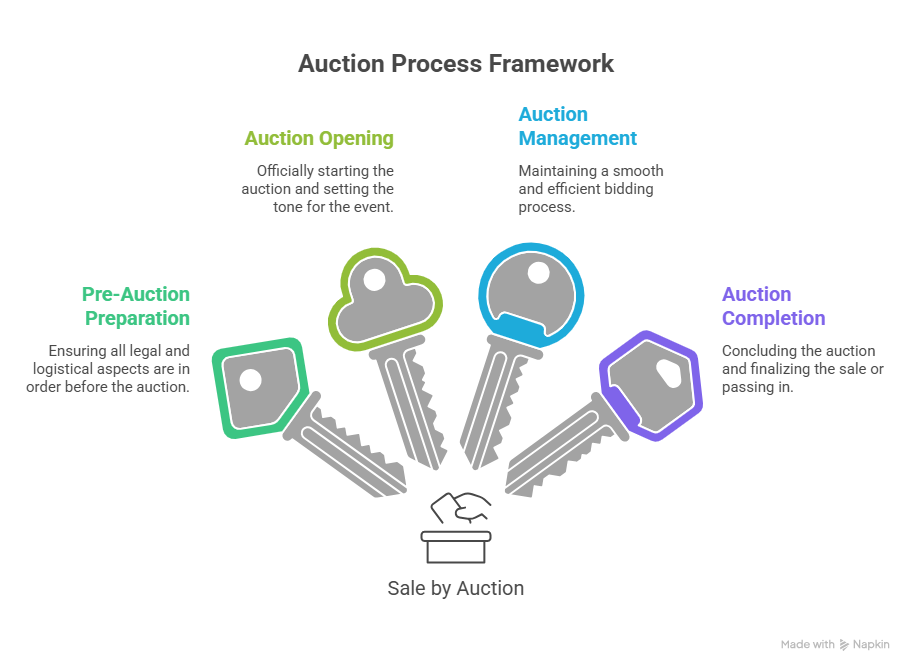
State legislation integrates with the real estate industry’s wider regulatory framework, ensuring that the sale of properties via auction adheres to transparent, fair, and ethical standards. This integration provides consistency across sales methods, whether private treaty or auction, contributing to the industry’s professionalism and reliability, thus instilling public confidence.
Where can the student go to find out more information about state legislation for conducting and completing a sale by auction?
- General rules for conducting an auction of goods
- The law and authority of auctioning real property
- Skillmaker
What job roles would be knowledgeable about state legislation for conducting and completing a sale by auction?
Roles include:
- Auctioneers
- Real Estate Agents
- Property Lawyers
- Compliance Officers
- Real Estate Regulators
What is the resemblance of state legislation for conducting and completing a sale by auction to sports, family, or schools?

In sports, state legislation for auctions is much like the rules of the game ensuring fair play and seasonal consistency. For families, it can be compared to household rules that keep order and fairness. In schools, it aligns with academic standards or codes of conduct that ensure fairness and discipline, guiding processes to achieve desired outcomes effectively and equitably.
(The first edition of this post was generated by AI to provide affordable education and insights to a learner-hungry world. The author will edit, endorse, and update it with additional rich learning content.)
(Skillmaker – 2025)- About the Author
- More info

Workskill training for all
